
The whole of it, step by step
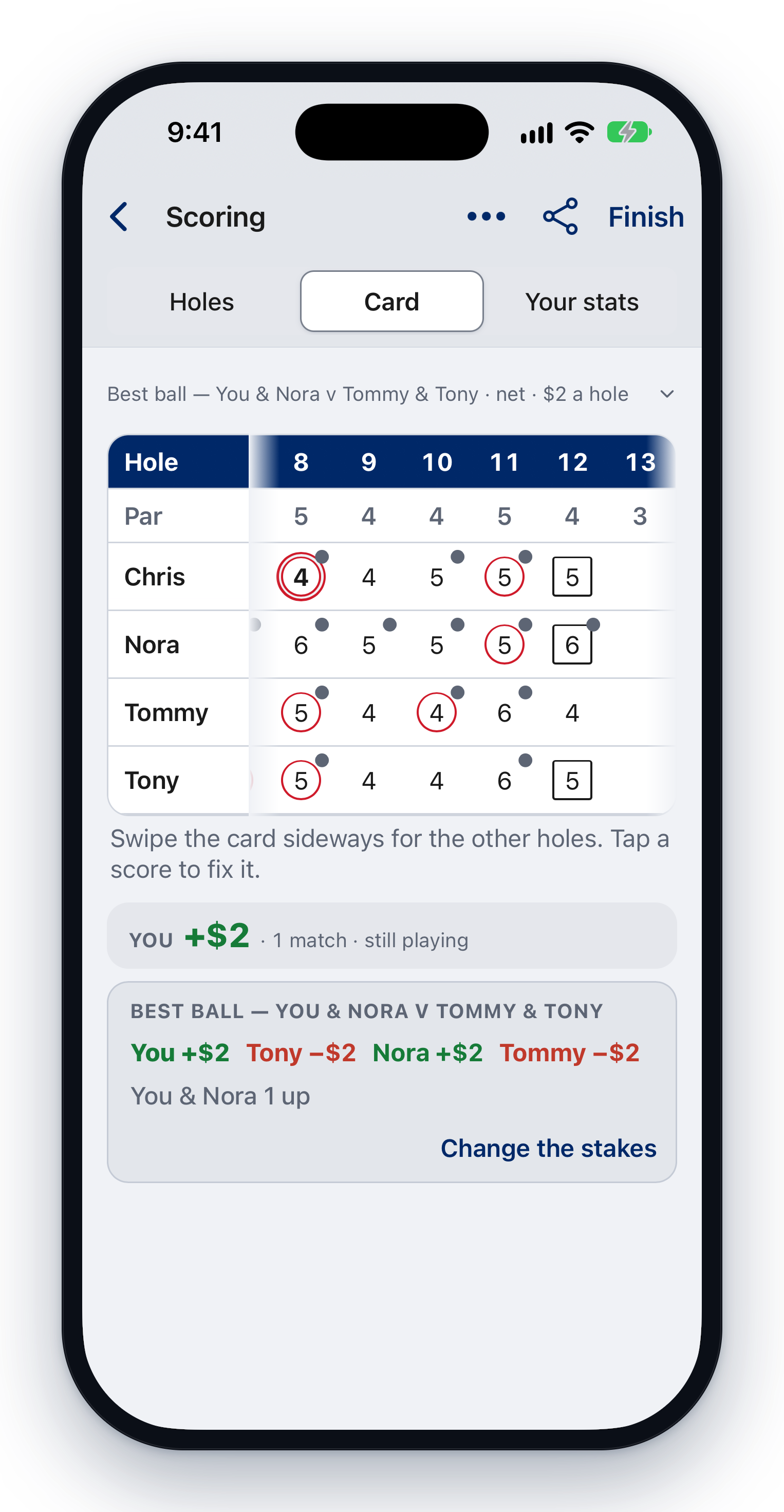
Every group has the golfer who does the strokes in their head on the first tee, and every group has had the argument on the 14th green about whether they did them right. A handicap app has one job: take that number out of anybody’s head and put it where everyone can see it before a ball is struck.
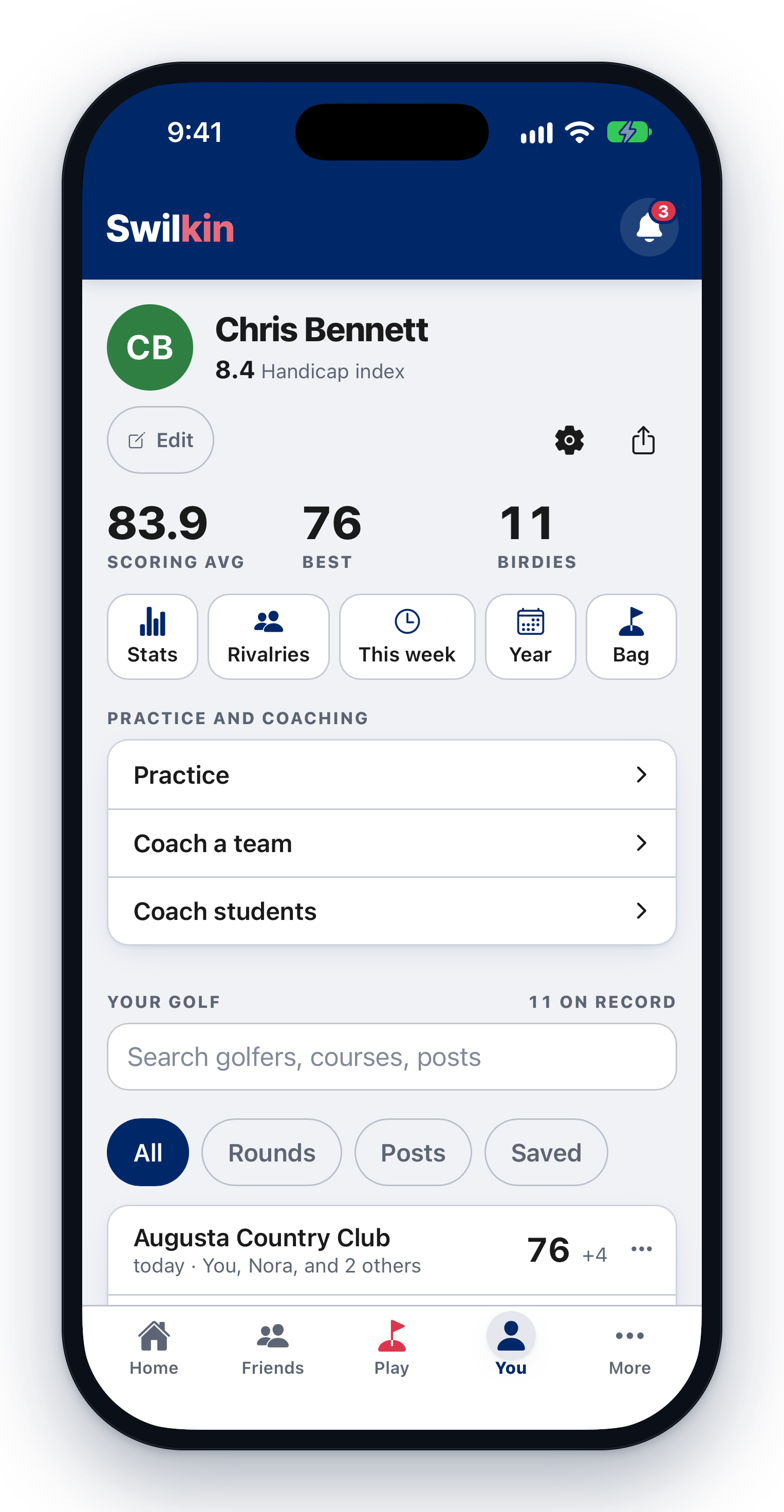
Here is the whole promise, and its limit, before anything else. Type your WHS or GHIN index on your profile once, and every net score, board, and bet uses it, for the tees you actually played. Swilkin applies your index. It does not calculate one and it does not post scores to GHIN.
This page is about exactly what Swilkin works out for you, and, because it matters more, exactly what it leaves to your group or your committee. If you want the concepts from the ground up first, golf handicaps, explained is the place to start.
1. Your index travels. Your course handicap does not.
Your handicap index is the portable number: the one you carry from course to course. What you actually play off on a given day is your course handicap, and it depends on the tees you are standing on:
- index × slope ÷ 113, plus the course rating minus par, rounded to a whole number.
- A 12.4 index from tees rated 72.1 with a slope of 131, on a par 72, plays off 14 that day.
- Move to a tougher set of tees and the same 12.4 plays off more.
Swilkin works that out from your own tees. When the tee you played publishes a stroke index for every hole in play, your strokes come off that card, so a group playing three different sets of tees gets three honest numbers, not one borrowed from whoever set the round up. That needs each tee to be rated: a tee with no slope and course rating has nothing to calculate from, so nobody playing it gets strokes from their index, only a number somebody types in.
⚖️ And it is stored on the round, not re-read later. Change your index next month and the strokes in a round already under way do not move. A settled Saturday stays settled.
2. Where the strokes actually land
A course handicap of 14 is fourteen strokes, and they go on the fourteen hardest holes by the stroke index on the card you are playing.
- Over 18, the count wraps: a 22 gets a stroke on every hole and a second one on the four hardest.
- A plus handicap gives strokes back instead, and it gives them back on the easiest holes: a +2 returns one on each of the two lowest-ranked.
- A half stroke lands on exactly one hole, the next-hardest in line after the full strokes run out, so nobody has to agree on the spot where half a shot happens.
⚠️ If the tee in play does not rank every hole, the app does not invent a ranking: your strokes come off the round’s tee card instead, and if that does not rank every hole either, the net game is settled as scratch.
3. Nine holes are their own decision
A nine-hole round halves the course handicap, which is where half strokes come from: a 13 plays off 6½ for nine. There are two defensible answers about that half, and the game you are playing decides which one applies:
- Hole-by-hole games keep the half: match play, skins, wolf, nines, and the rest. A half stroke is a real thing on a single hole, so it stays: the 13 plays off 6½.
- Total-score games round it the USGA way: stroke play, Stableford, modified Stableford and Vegas. You cannot add half a shot to a total (and in Vegas you cannot write 4½ into a two-digit number), so the 13 plays off 7.
- A Nassau follows its legs: match-play legs keep the half, medal legs round it.
- A leaderboard always rounds it, whatever the game. So a nine-hole board and a nine-hole match between the same golfers can sit half a stroke apart: that is the two answers above, not a bug.
Nobody on the first tee has to toggle it, and nobody can pick the version that suits them after the fact. How 9-hole strokes work, in brief.
4. What is automatic, and what your committee decides
This is the part most handicap apps blur, and it is the part your money depends on.
Automatic: the shared-ball formats. When a team plays one ball, the Rules publish how the team’s handicaps combine, and Swilkin applies those shares with the lowest handicap weighted heaviest:
- Foursomes (alternate shot): 50% and 50% of the pair.
- Greensomes: 60% of the lower handicap, 40% of the higher.
- Scramble: 35/15 for two, 30/20/10 for three, 25/20/15/10 for four.
Build a one-ball side bigger than the Rules publish a row for and the app tells you on the screen that the split is your committee’s call, instead of quietly inventing a number and calling it the format’s.
Your decision: the percentage allowances. The 95% for individual stroke play, the 90% for a four-ball match, the 85% for four-ball stroke play: those are committee decisions in a competition, so on a tournament board they are a number whoever runs the event sets.
And a side bet decides its own strokes. When four of you talk a match on the first tee, the bet says how it plays: straight up, off each golfer’s handicap, or with a number you set for any golfer. If your group plays the 90%, type the strokes that gives. By default the strokes are given off the low handicap, which the bet screen says in those words, and one switch gives everybody their full handicap instead. An event’s allowance never changes a bet, and if a golfer’s handicap is corrected after the fact, Swilkin asks before it changes a bet’s strokes. The full allowance chart, by format.
5. The honest limits
- Swilkin is not a handicap authority and does not post scores to GHIN. You can keep your GHIN number on your profile; nothing is sent anywhere. If your league needs indexes maintained by an authority, that requirement decides your software before anything else does.
- No index means scratch. Leave it blank and net games treat you as scratch: the app will not make one up for you. What happens without an official index.
- The allowances above are not automatic outside the shared-ball formats, and that is on purpose. A percentage your group never agreed to is exactly how a sandbagging argument starts.
Where to start
Put your index on your profile, pick rated tees when you start a round, and add your group, even the buddy who has never had an official number, who plays off scratch until somebody types one in.
Does it do handicaps? The short answer. · Stableford, where net scoring shows up most · Golf handicaps, explained