
leaguesrecords
How to Run an Order of Merit Season
How to build a golf order of merit — points by finish, best-N scoring, which events count, and the tiebreak rules that stop an argument in November.
An order of merit is a season-long points table. Every event your group or society plays awards points by finishing position, the points accumulate, and at the end of the year somebody is the champion of the whole season rather than of one Saturday.
It is the single highest-value thing you can add to a golf group, and it costs nothing. Twelve separate outings become one story with a leader, a chaser and a run-in. People who would have skipped the October medal turn up because they’re 14 points off second.
Here is how to build one that survives the season.
The five decisions
Make all five before the first event, write them down in one place, and never change them mid-season. Every order-of-merit argument in history is one of these five having been left unstated.
1. Which events count?
Name them. “All society events” is not a rule — somebody will ask about the away trip, the Wednesday roll-up and the charity day, and whatever you answer in June will look convenient.
A structure that works: majors count double. Pick three or four events a year as majors (the club championship, the away weekend, the season finale) and double their points. It gives the calendar shape and makes the big days feel big.
⚠️ And decide explicitly whether the club championship feeds the order of merit or stands apart. Both are defensible — it’s a scratch event with a different field, so a lot of societies keep it separate — but it must be decided in writing, because the person who wins it will assume it counted.
2. How are points awarded?
Three real shapes:
Points by finishing position. 1st = 20, 2nd = 17, 3rd = 15, 4th = 13, then down by twos, with everybody who finishes getting something. This is the standard and it’s the right default. The crucial feature is the bonus gap at the top — a big step between 1st and 2nd is what makes winning matter, and a flat table makes turning up matter more than playing well.
Points by result, not position — a flat allocation for turning in a card, plus extra for a top finish. Better for a society whose whole problem is attendance.
Match points. Win your match, take the points; halve it, split them. Only works with a stable roster who’ll actually pair up each week. (The league version of this.)
Award points for showing up, whatever shape you pick. One or two points for a signed card is what keeps a 22-handicap in the season in September.
3. Cumulative, or best N?
This is the decision that decides whether your season is alive in August.
Cumulative — every event counts, add them all up. Simple, and it punishes anyone with a holiday. By midsummer the guy who missed three events is mathematically dead and stops coming, which costs you a player and costs everyone else a competitor.
Best N of M — count each player’s best 8 results out of 12 events. This is almost always the right answer. A vacation, a work trip and a wedding don’t eliminate anybody, and the table stays genuinely competitive into the last month because the leader has to keep improving their counted set rather than just showing up.
Rule of thumb: count about two-thirds of the events. Best 8 of 12, best 6 of 9, best 14 of 20 for a weekly league.
4. Gross or net?
Net, with allowances — unless your field is all single figures, in which case gross is a fair fight and simpler. A net order of merit is the only way a 20-handicap has a reason to play in April.
If you run net, say which allowance applies to which format, once, before the season. (The allowance chart.)
And say what happens when somebody’s handicap moves mid-season: the honest answer is that each event is scored on the handicap they had on the day, and the table is a record of results, not a thing that gets recalculated when an index changes. Freeze the past.
5. How do ties break?
This one gets skipped and then decides your champion, in front of everybody, at the presentation.
Pick one and post it:
- Most wins, then most second places, then most thirds. The simplest and the most intuitive.
- Head-to-head over the season — how the tied players finished relative to each other.
- Countback on the final event’s card — hole by hole from the 18th backward, and the first hole they differ on decides it. The traditional method, and it always produces an answer.
- Co-champions. A completely legitimate choice. Two names on the board is better than a tiebreak nobody agreed to.
(How ties get broken in the app.)
The mechanics that make it feel real
One link, always current. The table has to be somewhere anybody can open from the group chat without logging in. This is not a nice-to-have — it is the order of merit. A table that lives in a spreadsheet somebody updates on Thursdays is a table nobody believes.
Publish it the night golf happens. Not the following week. The 24 hours after a round is when people care.
Say who moved. “Dave up to 3rd, Rob’s lead down to 9” is the content. A bare table is a list; movement is a story.
Name the run-in. Announce the finale date at the start of the season so the last month has stakes. Then present the trophy properly and put the winner’s name somewhere permanent. (Why the permanent record matters.)
A worked example
A 30-player society, 12 events a year:
| Counting events | all 12, best 8 count |
| Majors (double points) | spring meeting, away weekend, season finale |
| Points | 1st 20 · 2nd 17 · 3rd 15 · 4th 13 · 5th 11 · then 10 down to 1 · 1 point for a signed card |
| Scoring | net Stableford, 95% allowance |
| Tiebreak | most wins, then most seconds, then countback on the finale |
| Club championship | separate — scratch, not in the order of merit |
That fits on one side of paper, answers every question anybody will ask, and will run for years without amendment.
Where the app fits
Swilkin treats a season as a real object rather than a spreadsheet bolted onto events.
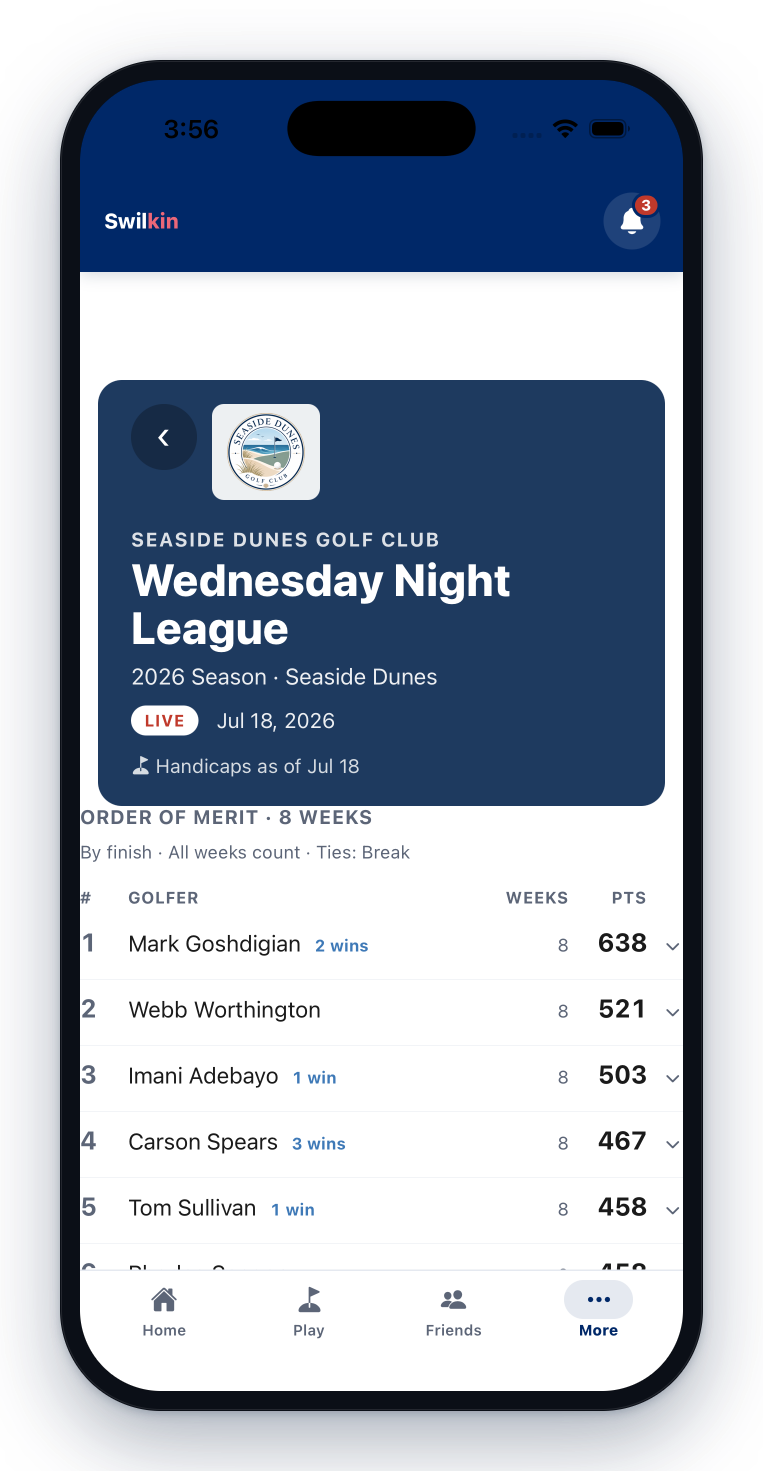
You set a points table by finishing position (fractional points are fine, for the societies that like halves), choose cumulative or best-N with your own N, and pick how ties resolve — by countback or by sharing the points. The standings roll up automatically as each event finishes; there is no Thursday-night maintenance.
Three details worth knowing because they’re the ones that bite:
- An event that shouldn’t count doesn’t have to opt out — it just never opts in. The scheme attaches to the events that feed the table, so your club championship can sit right beside the season without its finishes being scored as a week of it.
- A points scheme can attach to a single competition inside an event, not only to the event as a whole — so a gross board and a net board at the same meeting can feed different tables.
- Countback is spelled out, not just applied. The board prints the actual rule with the actual hole numbers in it — “ties break hole by hole from the last hole played backward — hole 18, then 17, then 16… down to 1 — and on the first hole they differ, fewer strokes wins” — or the USGA ladder (last 9, last 6, last 3, last 1) if you chose that instead. Nobody has to take the committee’s word for how a tie was decided.
And the whole table is a link anybody can open, with no account.
Run a league or a season · can it run a season-long league? · free for golfers.
Also worth reading: how to run a weekly golf league and Stableford points explained, since most orders of merit are scored on points.