
Two sides
🎯Nassau golf bet: rules, presses, and a settle-up calculator
A Nassau is three bets in one round: the front nine, the back nine, and the full 18. Lose the front and you still have two bets to play for. Below you’ll find the rules, a worked round, and a calculator that settles your card the way the Swilkin app does.
Nassau calculator ↓The rules
Two sides play, one golfer each or two-man teams. You agree a price for each leg before you tee off. “A $5 Nassau” means $5 on the front, $5 on the back and $5 on the 18. Groups that want the 18 to matter more play $5/$5/$10.
Each leg is its own bet, and the side that wins it collects that leg’s price. On a team, every golfer on the losing side pays the price and every golfer on the winning side collects it. A leg that ends level is a push: no money moves on it.
In the app the three legs are the Front, the Back and the Nassau. The Nassau is the 18-hole bet, the one some groups call the overall. Win all three and you swept it.
| Nassau | Most at stake | Win 2 of 3 |
|---|---|---|
| $2/$2/$2 | $6 | +$2 |
| $5/$5/$5 | $15 | +$5 |
| $5/$5/$10 | $20 | $0 or +$10 |
| $10/$10/$10 | $30 | +$10 |
Each press adds its own price on top. Win the front and the Nassau on a $5/$5/$10 and lose the back, and you are up $10.
Strokes or holes won
Most groups settle each leg on strokes. Add up your side’s score for the nine, and the lower total wins it. Swilkin starts every Nassau on strokes.
Head-to-head matches often play holes won instead. The lower score wins each hole, a tie halves it, and the side ahead when the leg ends wins it. A leg can finish early: 3 up with 2 to play is a 3&2 win, and it pays the same price as a 1-up win.
The two ways can crown different winners off one card. Shoot 38 with a blow-up 8 while your opponent shoots 40 and wins five holes: you take the front on strokes and lose it on holes won. Pick one on the first tee.
On a team, your side’s score on each hole is its better ball.
Presses
A press is a new bet that starts on the next hole and runs to the end of the nine or the end of the round. The side that is down usually calls it, at the price of the leg it is losing unless you name another. A press gives the side that is down a fresh bet on the holes that are left.
An automatic press starts itself when a side goes 2 down on a nine, or at whatever number you set. If that press goes 2 down too, another one starts. Swilkin presses each nine on its own and leaves the Nassau leg to be pressed by hand, so one bad stretch never starts two presses at once.
On a strokes Nassau, 2 down means 2 strokes behind on that nine. An automatic press needs at least one hole left on the nine. Automatic presses stay off unless you turn them on.
Ties and pick-ups
A leg that ends level pays nobody. On holes won, a halved hole moves nothing.
Pick up and you lose the hole. On holes won, the other side takes that hole unless your partner finished it. On strokes, your side has no total for that nine, so you lose the leg and the 18 with it. A group can choose to count a pick-up as net double bogey instead.
A worked round
Alex and Ben play a $5 Nassau on strokes. Alex wins the front 37 to 39. After 13 holes Alex trails the back nine by 2 strokes, 17 to 15, so he presses for $5 from the 14th to the 18th.
| Bet | Alex | Ben | Result |
|---|---|---|---|
| Front (1–9) | 37 | 39 | Alex wins $5 |
| Back (10–18) | 37 | 36 | Ben wins $5 |
| Nassau (1–18) | 74 | 75 | Alex wins $5 |
| Press (14–18) | 20 | 21 | Alex wins $5 |
Alex wins three bets and loses one. Ben pays Alex $10. Press “Fill in the example” in the calculator to see this card hole by hole.
Variations
Swilkin plays each of these. Agree them before the first tee.
- A price per leg, like $5/$5/$10, instead of one price on all three.
- Net: strokes off the low handicap, marked on the holes they fall. Your strokes over a nine or a press are the round’s strokes on those holes.
- Three sides or more: every pair plays its own Nassau, or the whole field plays one medal Nassau where low total takes each leg. Golfers tied for low on a leg split it.
- Nine holes: a nine-hole Nassau is one bet.
- Birdies on top: a birdie is a dot and an eagle counts two, unless you say every one counts once.
Nassau calculator
Set your terms, enter the card, and it settles as you type. A blank on a hole somebody else finished counts as a pick-up.
Swilkin keeps the score and settles it while you play, and puts every bet on the receipt.
Start a round on SwilkinHow Swilkin runs it
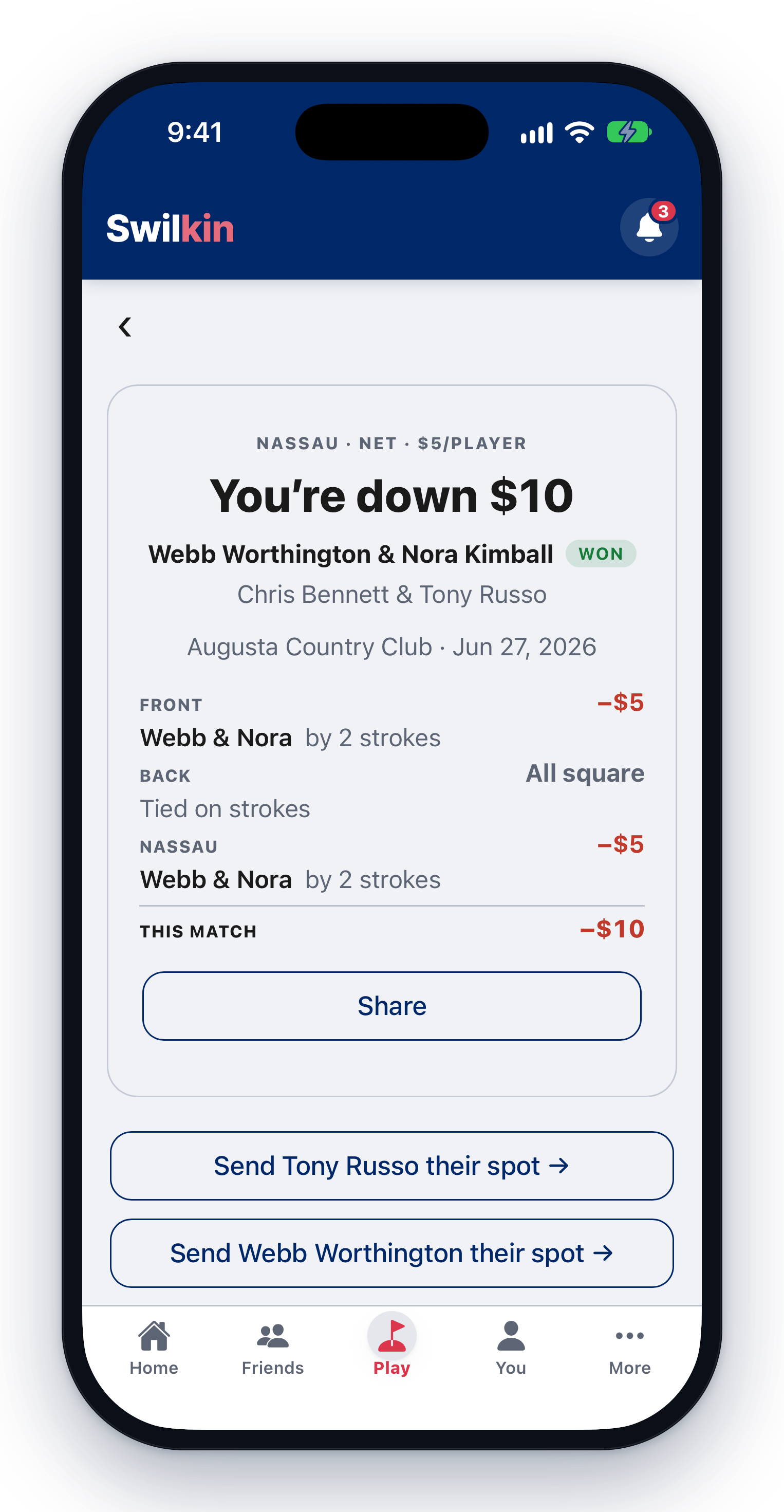
Swilkin plays the Nassau the way your group does: one price for all three legs or a price per leg, strokes or holes won, a pair of golfers or two teams. Press any leg from the scoring screen, or let each nine press itself at 2 down. The settle screen lists every leg and every press on its own line.
Questions golfers ask
How much is a $5 Nassau?
It is $5 on each of the three bets, so $15 at most before presses. Win two legs and lose one and you are up $5.
Is a Nassau match play or stroke play?
Either. Most groups settle each nine on strokes, and Swilkin starts there. Pick holes won for a straight match.
Who can call a press?
Usually the side that is down. A press is one more bet from the next hole to the end of the nine or the round, so agree before the first tee who may call one and how often.
Does the 18-hole bet press itself?
Not in Swilkin. Automatic presses run on each nine, and you press the Nassau leg by hand if you want one.
What happens when a leg ties?
It is a push. Nobody pays on that leg.
What if somebody picks up?
They lose the hole. On a strokes Nassau that leaves their side with no total, so they lose the nine and the 18.