
bettingsettling
The Nassau Bet, Explained (Match Play vs. Stroke Play)
What a Nassau is, how the front-nine, back-nine, and total bets work, the difference between match-play and stroke-play Nassau, and where presses fit.
Looking for the quick reference? The rules live at Games → Nassau: this post is the longer story.
The Nassau is the most popular bet in golf, and one of the most misunderstood. At its heart it’s simple: a Nassau is three bets in one round.
The three bets
A Nassau splits the round into three separate wagers, each usually for the same stake:
- The front nine (holes 1–9)
- The back nine (holes 10–18)
- The total (all 18 holes)
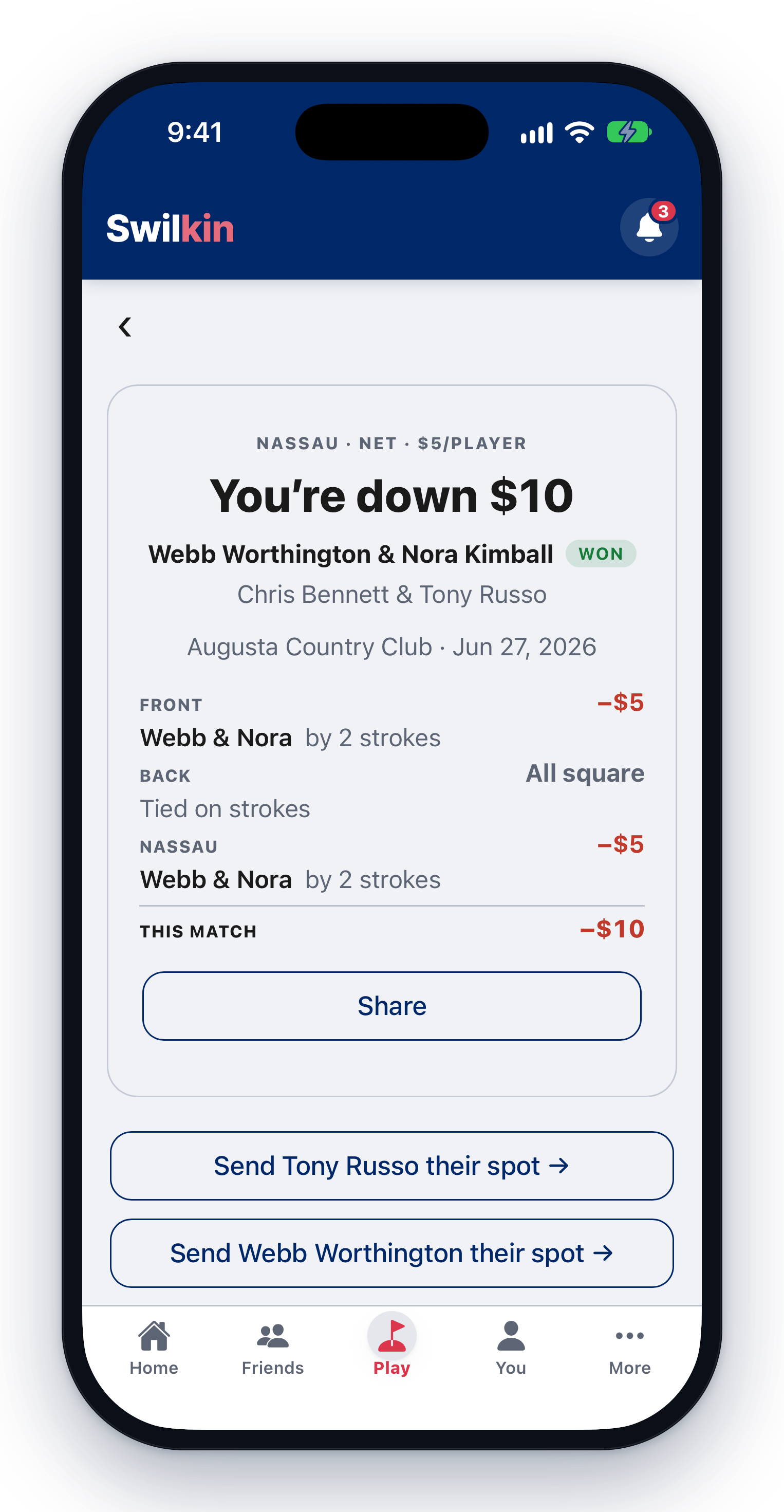
So a “$5 Nassau” is really $5 on the front, $5 on the back, and $5 on the total: up to $15 on the line. Win all three and you take $15; split them and you might walk with $5 or break even.
Match play vs. stroke play
Here’s where people get tripped up. There are two ways to score a Nassau:
Match-play Nassau (the common one)
Each nine is a match: you win a hole, lose a hole, or halve it, and whoever is “up” the most holes wins that nine. The key wrinkle is the total:
The total isn’t “who won the front plus who won the back.” It’s the cumulative 18-hole match.
So you can be 3 up after the front, lose the back 2 down, and still win the total 1 up (3 − 2 = 1). That’s the classic Nassau swing.
Stroke-play (medal) Nassau
Each leg is decided by total strokes instead of holes won: lowest score on the front wins the front, lowest on the back wins the back, lowest 18-hole total wins the total. Simpler to tally, and it rewards consistency over hole-by-hole grit.
What’s a “press”?
When you fall two down in a match, you can “press”: start a new bet for the same stake over the remaining holes. It’s a way for the losing side to get even. Presses can stack on presses, which is how a friendly $5 Nassau turns into a much bigger number by the 18th.
Let the app do the math
Tracking a Nassau with presses in your head is a recipe for an argument on the 18th green. Swilkin settles it automatically (match or stroke, with presses, net or gross) and tells you exactly who owes who when you walk off.