
eventsclub sites
Golf Genius Alternatives for a Small Club
What to look for in tournament software when an enterprise platform is more than your club needs — the questions to ask, and where the honest trade-offs are.
Try Swilkin for your club — free
Golf Genius is the industry standard for tournament management, and if you run a state association, a 400-player member-guest with sponsor reporting, or an event where scores need to land at a handicap authority, it is very likely the right answer. This post is not an argument that it isn’t.
It’s for the other club — the 120-member place with a Wednesday league, a club championship, a member-guest and a couple of charity days, run by a pro shop of two people and a volunteer committee. That club keeps ending up in one of two bad states: paying for a platform built for a much bigger operation and using a fifth of it, or running the whole season on a shared spreadsheet and a WhatsApp group.
Here’s how to work out which one you actually are, and what to ask of any alternative.
Swilkin today, in one table — every row checked against the app’s code, the nos included:
| What your club needs | Swilkin today |
|---|---|
| The club’s own public site | Yes — a multi-page site at app.swilkin.com/yourclub, once you publish it |
| Leaderboards members open without an account | Yes — once the organizer opens the event to anyone with the link |
| A clubhouse TV board | Yes — a full-screen board for the TV |
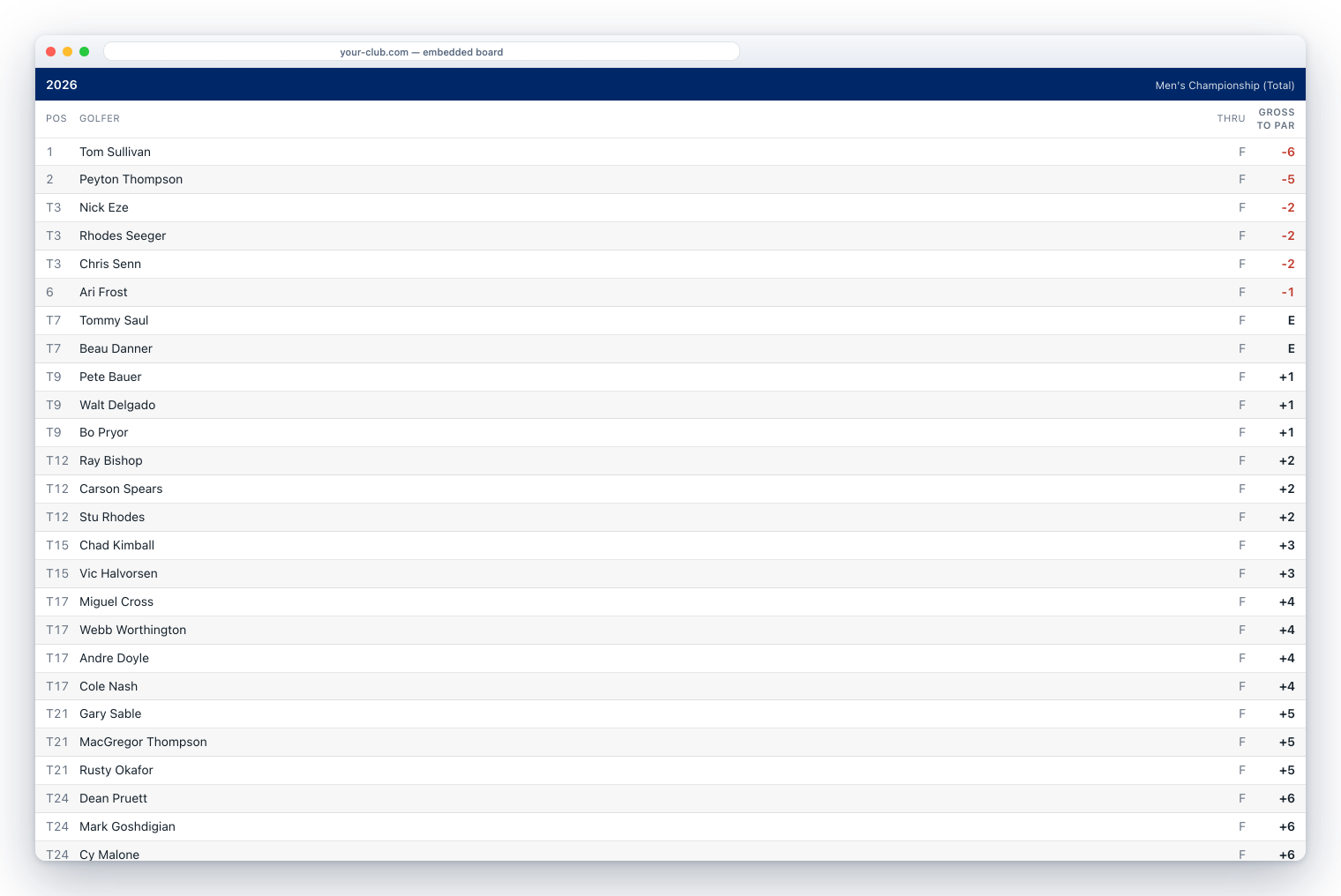
| A live board embedded on your own website | Yes — paste the embed code into a page you already have |
| League standings: best N of M, points tables, countback | Yes — chosen in the event’s scoring setup |
| Scoring golfers who won’t make an account | Yes — added by name; each printed card carries its group’s scoring code |
| Registration with a field cap and waitlist | Yes — entries past the cap go on the waitlist |
| Tee times emailed to the field | Yes — golfers with no email on file are skipped |
| Calcuttas, and scores locked by an official | Yes — an official role can lock a round |
| Posting scores to GHIN or a handicap authority | No — a GHIN number can be stored; nothing is posted anywhere |
| Taking entry fees or card payments | No — settle-up opens Venmo, PayPal or Cash App with the amount filled in |
| A native Android app | No |
| Tee-time booking with a course | No — your own tee sheet, not a course’s booking system |
| A public bracket page | No — brackets live in the organizer’s setup screens |
First: be honest about what you run
Write down your real calendar. Not the aspirational one.
You need a full enterprise platform if any of these is true:
- Scores must be posted to a handicap authority — GHIN, or your national body. This is the single hardest requirement to work around, and it eliminates most alternatives instantly. Nothing that isn’t an authorized service can do it, and any tool implying otherwise should be treated with suspicion.
- You run multi-course, multi-day championships with a committee that needs published conditions of competition, appeals and a rules official.
- You’re an association or a tour, not a club — many clubs under one umbrella, one ranking.
- Your pro shop already lives inside a management suite that the tournament module plugs into, and moving off it means moving everything.
- Somebody senior signs off on a sponsor report that has to look a particular way.
If two or more of those are true, stop reading comparison posts and buy the enterprise thing. You will need the phone number that comes with it.
You’re probably paying for more than you need if:
- Most of your events are one round, one course, one day.
- Your field is under 150 and everybody knows everybody.
- The scores don’t leave the club — they decide a trophy and a Wednesday-night standings table, not an index.
- The person running events is a volunteer, and their real constraint is time on a Tuesday night rather than feature depth.
- Your members’ actual complaint is “I never know where the standings are”, not “the re-flighting logic is insufficient.”
The questions to ask any alternative
Ignore feature lists. Ask these seven.
1. What does it cost when the free trial ends, and is that per club or per player? Per-player pricing is what makes software expensive for a club whose field changes every week. Ask for the renewal number, not the first-year number.
2. Can a member see the standings without an account? This is the single biggest determinant of whether your league feels alive. If checking the table requires a login, 60% of your field will never check it, and the league will feel dead by mid-season even when it isn’t.
3. Can a player who refuses to install anything still get scored? Every club has fifteen of these people and they are often the ones on the committee. If the answer involves “they just need to download…”, the answer is no.
4. Who enters the scores, realistically? A system that assumes a staff member at a desk will not survive a Wednesday league. A system where one person per group can tap scores in, and a volunteer can also key a paper card at the turn, will.
5. Does it handle a season, or only events? A club year is a league, a championship and a member-guest that all feed one order of merit. If the software treats each event as an island, somebody is maintaining a spreadsheet on the side — which means the software didn’t actually replace the spreadsheet.
6. Can you put the leaderboard on the clubhouse TV, and can you embed it on your own website? These are the two surfaces members actually look at.
7. What happens to five years of records if you leave? Ask before you start, not after.
The honest trade-offs of going lighter
Anything cheaper is cheaper for reasons. The reasons worth knowing:
- No handicap-authority posting. Covered above, and it’s the big one. A lighter tool can do the WHS course handicap math on an index you give it — that’s public arithmetic — but it cannot be the place your index lives.
- Thinner rules and committee machinery. If you need published conditions of competition, formal appeals and an audit trail that satisfies a governing body, that’s what the enterprise price buys.
- Less phone support. You’re likelier to be emailing a person than calling a support line.
- Younger. Fewer clubs have run a full season on it, which is a real risk and should be priced as one. Run one event on it before you run the championship.
If any of those is a dealbreaker for your club, that’s a legitimate answer and you now know it for a defensible reason rather than a vague one.
Where Swilkin fits, and where it doesn’t
Swilkin is built for the club that doesn’t need an enterprise platform — and it starts from the opposite end of the problem: the golfers, not the pro shop.
What that means concretely:
- Free for golfers — scoring, bets, stats, rivalries. The club and event tools are free today too; paid plans for clubs are planned, not live. (What it costs.)
- Your club gets its own multi-page public site at its own short address, app.swilkin.com/yourclub, with your colors, photos, sponsors and permanent winners’ boards. It is the club’s page, not a profile inside the app — though it is on our domain, not a custom one. (How that works.)
- Standings and leaderboards are readable without an account. Paste the link in the group chat and it opens.
- A clubhouse TV mode and an embeddable board for the club’s existing website.
- Seasons are first-class, not an add-on: best-N-of-M leagues, order-of-merit points tables, round-robin match play, countback tiebreaks, and a champion at the end. (Running a league.)
- Players who won’t make an account still get scored — added by name, with a per-group scoring code on the printed card.
- The betting layer is real, which no tournament platform has, because it was built for Saturday golf first: twelve settled game types, calcuttas, side bets between players in an event, and one settle-up at the end.
And plainly, what it does not do:
- No GHIN posting. It is not a handicap authority. It does the course-handicap math on the index you give it, and that’s all.
- No payment processing — not for entry fees, not for sponsorships. Registration collects names, not money.
- No native Android app yet (the web app works on Android), and no tee-time booking.
- No public bracket board. Match play runs three ways as a whole-event format — a seeded single-elimination bracket (byes handled, winners advance), a match-points league, and Ryder-Cup style cups. But the bracket lives in the organiser’s setup screen: there is no public bracket page, no TV bracket and no embed, so today the draw gets shared as a screenshot. (Running a cup.)
- It’s early. That is the honest headline. Run your Wednesday league on it and see, before you put the club championship on it.
The test that actually settles it
Take your next real event — not a demo, the actual one on the calendar — and set it up in whatever you’re considering. If you can build the field, print the cards, get a board on a screen and finish the night with standings your members can open from a text message, it does your job. If you can’t, no feature list was going to save you.
More on running club golf: how to run a club tournament · club championship formats · run an event.